
Technical Guide 12 Min Read

Striker Hellcat Engine Specs — Power, Performance & What to Expect

A deep technical dive into the supercharged 6.2L HEMI V8 that powers every striker Hellcat. Horsepower, torque, 0-60 times, quarter mile runs, cooling systems, reliability, and why this engine is one of the greatest ever built.

Browse our Hellcat inventory · Read the Hellcat buyer's guide · Chat on WhatsApp
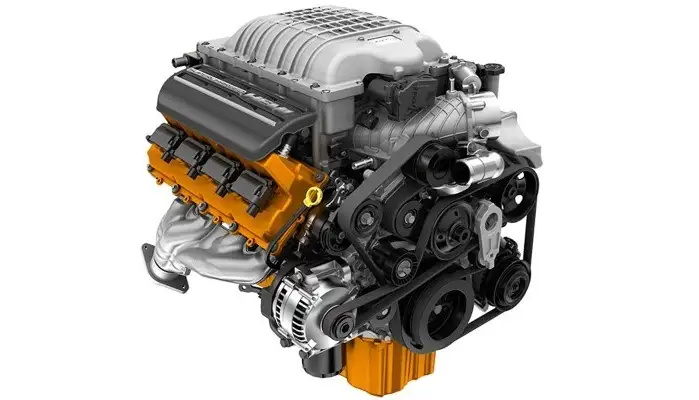
The 6.2L Supercharged HEMI V8 — An Engine Like No Other

At the heart of every striker Hellcat sits the legendary 6.2-liter supercharged HEMI V8 — internally designated the Hellcat engine by Dodge and codenamed "Fury." This isn't a modified or aftermarket motor. It's a purpose-built, factory-engineered powerplant designed from the ground up to deliver extreme horsepower while maintaining the reliability and drivability of a daily driver.

The engine uses a 2.4-liter IHI twin-screw supercharger mounted in the valley between the cylinder banks. This supercharger force-feeds compressed air into the engine at up to 11.6 PSI of boost in the standard Hellcat and 14.5 PSI in the Redeye and Jailbreak variants. The result is an immediate, violent wall of torque that pins you to the seat the instant you touch the throttle. There's virtually zero turbo lag — the power is instantaneous because it's a supercharger, not a turbocharger.

The engine block is cast-iron for maximum strength, with forged steel connecting rods, sodium-filled exhaust valves, and a forged steel crankshaft — all built to handle the enormous pressures of forced induction. The heads are aluminum for better heat dissipation. Every component was overengineered from the factory, which is why the Hellcat engine has earned a reputation as one of the most reliable high-performance engines ever mass-produced. Learn more about Dodge's engineering at Dodge.com.

Core Engine Specifications
Displacement
6.2L
376 cubic inches
Configuration
V8
90-degree HEMI
Forced Induction
2.4L
IHI Twin-Screw Supercharger
Transmission
8-Spd
TorqueFlite 8HP90 Auto
Block Material
Cast Iron
Maximum strength under boost
Redline
6,200 RPM
Peak power at 6,000 RPM

Power Output by Variant

While all Hellcat engines share the same 6.2L supercharged V8 architecture, Dodge released several variants over the years — each with progressively more power. Here's how they stack up:

Hellcat Engine Variants — Full Breakdown
Variant
HP
Torque
Boost
0-60
1/4 Mile
Hellcat
2015–2023
707
650 lb-ft
11.6 PSI
3.6s
10.96s
Hellcat (Charger)
2019–2023
717
650 lb-ft
11.6 PSI
3.6s
10.96s
Redeye
2019–2023
797
707 lb-ft
14.5 PSI
3.4s
10.50s
Redeye Jailbreak
2022–2023
807
707 lb-ft
14.5 PSI
3.4s
10.50s
Demon
2018 (limited)
840
770 lb-ft
14.5 PSI
2.3s
9.65s
Demon 170
2023 (limited)
1,025
945 lb-ft
21.3 PSI
1.66s
8.91s

The difference between the standard Hellcat and the Redeye comes down to the supercharger. The Redeye uses the larger supercharger from the Demon — with a higher redline, bigger throttle body, and increased boost pressure. This pushes output from 707/717 HP to 797 HP with an additional 57 lb-ft of torque. The Jailbreak adds another 10 HP to reach 807, along with the ability to mix and match options that were previously locked to specific packages.

For most striker car buyers, the standard Hellcat (707/717 HP) is more than enough power — it's already faster than 99% of cars on the road. The Redeye and Jailbreak are for buyers who want the absolute maximum and are willing to pay the premium. View our current Hellcat inventory to see what's available.

Cooling Systems — How the Hellcat Stays Cool Under Pressure

Making 700+ horsepower generates enormous heat. Dodge engineered three dedicated cooling systems — on top of the standard engine cooling — specifically to keep the Hellcat engine running at optimal temperatures during sustained high-performance driving:

❄️
SRT Power Chiller
This system reroutes the air conditioning refrigerant to cool the charge air cooler (intercooler). When you activate it, the A/C essentially stops cooling the cabin and instead cools the intake air going into the supercharger. Cooler air = denser air = more power. This system can drop intake temperatures by up to 35°F during hard driving — giving you consistent power output lap after lap.
🔄
After-Run Chiller
When you shut the engine off after hard driving, the After-Run Chiller keeps the coolant pump and fans running to bring the supercharger temperature down. This prevents heat soak — where residual heat damages components after shutdown. The system runs automatically for several minutes after you turn off the car, protecting the supercharger bearings and seals without any input from you.
💧
Low-Temperature Circuit Cooling
The Hellcat uses a dedicated low-temperature cooling circuit for the charge air cooler, separate from the main engine cooling system. This means even when the engine is running hot, the supercharger intake air has its own independent cooling loop maintaining optimal temperatures. This dual-circuit design is what allows the Hellcat to sustain full power during extended track sessions without derating.

Hellcat Engine Reliability

One of the most common questions we hear from buyers: "Is the Hellcat engine reliable?" The short answer is yes — remarkably so. The Hellcat engine was built on the proven Apache/Hemi platform that has been in production since 2003. Dodge overengineered every critical component specifically because they knew owners would beat on these cars.

200K+
Miles reported by owners with zero major engine issues
1,000+
WHP capable on stock internals with a pulley and tune

Common reliability concerns and the reality:

Supercharger longevity: The IHI unit is incredibly durable. Failures on stock boost levels are virtually unheard of with proper maintenance.
Transmission reliability: The ZF 8HP90 8-speed is one of the strongest automatics ever made. It handles 700+ HP without breaking a sweat.
Oil consumption: Some owners report slightly higher oil consumption under hard driving — this is normal for high-output supercharged engines. Check oil levels regularly.
Tire wear: With 650+ lb-ft of torque hitting the rear wheels, tires don't last long if you drive aggressively. Budget for rear tires every 8,000–12,000 miles.

The bottom line: the Hellcat engine is one of the most reliable high-performance motors ever mass-produced. With basic maintenance — regular oil changes, coolant flushes, and supercharger belt inspections — these engines will last well beyond 150,000 miles without major issues. For Hellcat owners' real-world experiences, check the forums at Hellcat.org.

Performance Features That Come Standard

The Hellcat engine doesn't just make power — it comes wrapped in a package of performance technology that lets you use that power safely and effectively. Here's what every Hellcat includes from the factory:

🏁
Launch Control
Holds the engine at a preset RPM while you stage at the line. Release the brake and the car launches with maximum traction every time. Adjustable from 1,500 to 4,000 RPM depending on surface conditions and tire grip.
🔒
Line Lock
Locks the front brakes while leaving the rears free — letting you do controlled burnouts to heat your rear tires before a drag launch. Activated through the SRT Performance Pages on the touchscreen. Factory-approved burnouts.
📊
SRT Performance Pages
Built into the Uconnect touchscreen — shows real-time data including 0-60 times, G-forces, reaction times, 60-foot times, quarter-mile times, and engine performance gauges. You can also customize drive modes for suspension, traction control, transmission shift points, and steering weight.
🛑
Brembo Brakes
6-piston front / 4-piston rear Brembo calipers with 15.4" front and 13.8" rear two-piece rotors. These are the same brakes you'd find on Italian supercars — engineered to bring 4,500+ pounds from 150 mph to zero repeatedly without fade.
🔧
Adaptive Damping Suspension
Bilstein adaptive dampers with three modes — Auto, Sport, and Track. In Auto, the car rides like a luxury sedan. In Track, the suspension firms up for maximum grip and minimal body roll during hard cornering. The difference between modes is dramatic and adjustable on the fly.
🔑
Dual Key Fobs
The Hellcat comes with two key fobs — a black one that limits output to 500 HP and a red one that unlocks the full 707/717+ HP. The black key is perfect for valets or when you want a more relaxed driving experience. The red key unleashes everything the engine has to offer.

What to Expect When Driving a Striker Hellcat

If you've never driven a 700+ horsepower car before, here's an honest breakdown of what the experience is actually like — both the incredible highs and the practical realities:

🔊 The Sound
The supercharger whine is addictive. At idle, the Hellcat has a deep, aggressive V8 rumble. As you accelerate, the supercharger begins to whine — a high-pitched howl that gets louder with RPM. At full throttle, it's a symphony of supercharger scream and exhaust roar that's unlike anything else on the road. People will hear you coming from blocks away, and they'll stop to look every single time.
🚀 The Acceleration
Nothing prepares you for full-throttle in a Hellcat. The acceleration is violent — it pins you to the seat with a force that's genuinely startling the first few times. The speedometer climbs at an absurd rate. 60 mph arrives in 3.6 seconds. 100 mph comes seconds later. Triple digits happen almost accidentally if you're not paying attention. The power delivery is instantaneous because the supercharger has zero lag — it just hits.
🛣️ Daily Driving
Here's what surprises most first-time Hellcat owners: it's completely comfortable as a daily driver. With the suspension in Auto mode, the 8-speed cruising at low RPM, and the climate control keeping you cool, it drives like a normal luxury sedan. The ride is smooth, the cabin is quiet at highway speeds, and the seats are genuinely comfortable for long drives. You only unleash the beast when you want to — the rest of the time, it's civilized. This is especially true for the Charger, which was literally designed as a daily-driver muscle car.
⛽ Fuel Economy (The Reality)
Let's be honest — you don't buy a 700 HP car for fuel economy. The Hellcat is rated around 12 city / 21 highway MPG, but real-world numbers depend heavily on your right foot. Conservative highway driving can get you 22–24 MPG. Spirited driving around town drops to 8–10 MPG. A full tank (18.5 gallons) gets you roughly 200–300 miles depending on driving style. Premium 91+ octane fuel is required.
👀 The Attention
Even the Charger — which looks like a "regular sedan" — gets constant attention as a Hellcat. The hood scoop, the wide stance, the exhaust note, the Widebody flares — car people notice immediately. The Challenger is even more of an attention magnet with its retro muscle car styling. Expect thumbs-ups, questions at gas stations, and people pulling out phones to take photos. If you want to fly completely under the radar, the Charger is your best bet — but even then, you won't be invisible.
Experience 700+ HP for Yourself

Now you know exactly what's under the hood. The only thing left is to feel it for yourself. Browse our Hellcat inventory, pick your build, and we'll handle the rest — registration, title, and delivery to your door.

Scroll to Top